


The History of Cowell Boat Works
Cowell Boat Works was the brainchild of entrepreneur Thomas Cowell. Tommy, as he was known, had succeeded in a variety of ventures in the '40s and '50s near Erie, PA, including the Lake View drive-in movie theater and a pinball and slot machine company. But of all his endeavors, Cowell Boat Works was the one that allowed him to pursue his love of wooden boats.

Thomas Cowell (photo reprinted with permission from the Erie Times News)
Hear Thomas Cowell's son Richard reflect on his father's legacy:
The Original Cowell Logo
The swooping, fluid lines of the Cowell logo suggest smooth sailing in what one Cowell brochure called "the rough water boat." This original, unused logo from the Cowells' private collection is cast red plastic with a silver-grey matte finish. This logo design, seen most often in solid black, adorns all the surviving models (see our Models section).

Thomas Cowell began building boats at his home at the mouth of Six Mile Creek near Erie, PA, in the summer of 1953, in part because he couldn't find a 13' boat on the market that was suitable for the livery business. Click on the thumbnails of the brochures below to view high-resolution scans (Cowell family document scans courtesy of the Erie Maritime Museum.)

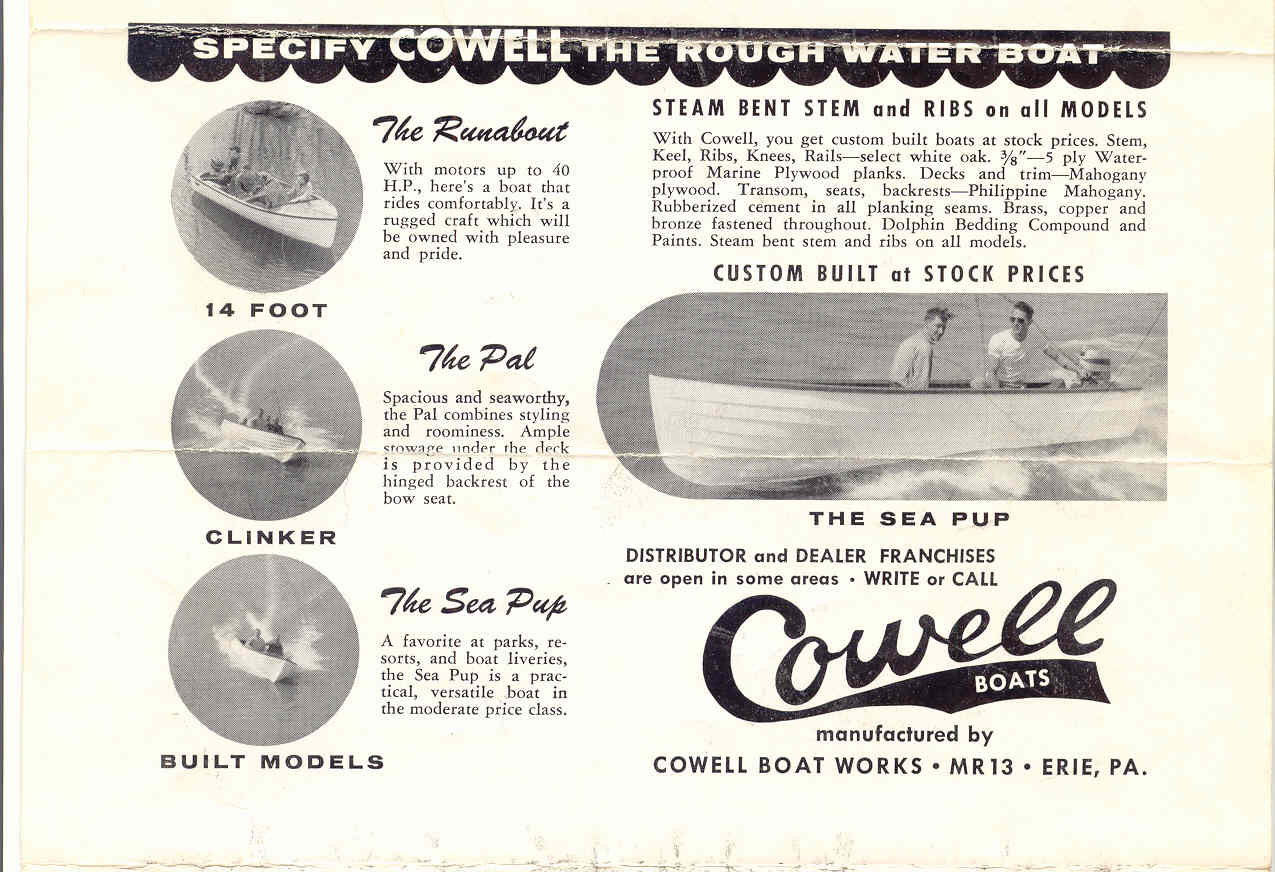

Boat rental operations were Cowell's largest customers, but as time went on, individual boaters ordered the 14-foot "Pal" and "Pride", and the 16-foot "King" and "Royal." At the height of its operation, Cowell produced the 17'7" "Sportsman", and the 20-foot "Windswept" inboard-outboard.

A "King" rolls off the line


|
Ron Smith, a young craftsman who worked at Cowell Boat Works during most of its history, is now a builder in North East, PA. Ron recently offered these reflections about Cowell Boat Works. "Back in those days we used to drive the truck to the lumber company near the tracks and pick up a train car load of wood, drive back to the shop where we would stack the wood for drying, forming, etc. Each boat was built entirely by hand. Each plank was cut and fit over a jig and then removed, brass screws and rivets were all applied by hand. The nose piece was formed by steaming , gluing, cutting to fit each boat. Ribs were all oak cut from rough cut oak, run through a machine, put in a steamer and bent over the jig."
A surviving Cowell Boat Works jig in 2007. Photo courtesy of the Erie Maritime Museum "Two other employees were Dick Brunner and Ray Scott. Joe Dedinsky was the boss of the outfit. Joe taught all of us how to use the tools. All employees, including myself, were from Harborcreek PA." "The boat works address was Erie, PA but it was located in Harborcreek Township. At that time my starting wages were 1.60 per hour. Every boat that came off the line during that time,I worked all the mahogany work....decks, rails, some of the painting. Pretty much from start to finish."
Cowell Boat Works checks showing the Erie address. "Joe made about 10,000 or 15,000 per year, and that included caring for the beach and all the tenants. I can not believe they ever made any money on the boats. I can say they were probably one of the best built boats you will ever find...not just because I was building on them but because all the material put into them was the best grade. Joe was an expert craftsman." [As evidenced by the two Kings picured below--Ed]
Many thanks to Ron for sharing his memories! Tom Dedinsky, son of Joe Dedinsky who headed the Cowell Boat Works operations for many years, adds these photos and comments about Cowell construction:
"This picture is of Tony - an employee of Cowell Boat Works (driving) and Tom Dedinsky, Ray and Johnny Meyers off the shore of Lake Erie in front of the Boat Works: they were either testing or taking photos for advertising brochures."
"This picture I believe was taken at the Cleveland, OH boat show. A dealer from Huron, OH used to cosponser with Cowell Boat Works every year in the show."
"The Boat Works started as a boat livery and Tom Cowell just wanted to make boats for his livery to rent at first: They built a small building and about 15 cottages, a snack bar on the beach and opened a Lake Erie Resort or Vacationland - Cowells Boats & Beach. Almost immediately, customers began asking if they could buy boats so Tom started building for sale and sought out dealers in the tri-state area to sell the boats. (Above): they were loading boats on a semi and trailer for transport ot a dealer they were sold to, from a storage barn about 1/2 mile from the Boat Works. The man on top in both photos with the hat is Joe Dedinsky. This is about the time they put an addition on to the building about doubling the size."
"This 1953 Pontiac Wagon was the first company car. Behind is the storage barn where the stored inventory: they also had a pickup truck and a larger stake body truck that pulled a trailer with three boats and a rack with one on the truck for delivery of four boats at a time to dealers."
"This is the first production 'livery boat' for their own use and for sale-It was a 13' 0".
"This is the first production 19'0" day cruiser at 6-Mile Creek in the livery area of the Boat Works. It was an outboard but they also made an inboard/outboard using Volvo engines in some of the day cruisers and the larger open boats. the people are Wanda, Patti, Larry & Tom Dedinsky- Joe's family."
"This is a picture of two brothers from Buffalo,NY: they bought matching Cowells - 16 1/2' Vikings and used to travel to the Boat Works via Lake Erie from Buffalo: These were taken off the shore at the Boat Works. They bought the boats from Hoover Marine in Pendleton, NY." Hoover Marine was located on Bear Ridge Road in Pendleton, NY, along the Erie Canal. Rick Hoover, whose father, Richard, owned Hoover Marine, got in touch with us to tell a little more of the story. 
Here's the Hoover family, three generations worth, standing in front of a Cowell Boat. Rick Hoover is in the front row on the right, with his Mom and Dad behind him. Siblings and grandparents complete the picture. "Back then, you could lease land along the Eric Canal very inexpensively. We had a ramp right down to the canal, so people could drive the Cowell Boats up and down the canal to see how they performed. In the '50s and early '60s, there weren't any speed limits on the canal either. People even water skied on the Erie Canal!"
Here's a little clearer picture of Richard (left) and Rick (right) during the heyday of Hoover Marine. "My Dad ran Hoover Marine from 1957 until 1962, and we sold lots of Cowell Boats. I remember as a kid, we'd go to their factory in Erie (Harborcreek) on Saturdays and buy and bring back two boats. Sometimes we would bring back trailers. While my Dad was doing business with Cowell, I was across the way at the beach. We would buy the boats unpainted, then when we got back to Hoover Marine, we would put a sheet of fiberglass on the bottoms of the boats to improve performance. I got a lot of experience as a kid working that fiberglass. Eventually, those skills helped me a lot in my collision business. My Dad also put on special windshields, which he designed, which were of the wooden frame type, with windshields that hinged open for ventilation, like a Model A." "I remember one special Cowell model that we bought. It was a 19-footer, very narrow, and decked all the way to the aft cockpit like a racing boat. I don't think it was a stock model. That was some boat!" "One of our family traditions was to go out in Cowell Boats on New Years Eve around Grand Island. I have lots of good memories about those outings. Also, every year, we would display Cowell Boats at the Buffalo Boat Show at the Masten Avenue Armory." Now back to Tom Dedinsky's comments:
"This is the first Day Cruiser, 19'0", inside the factory. Half of the building was for all the assembly/rough-cut work and millwork, etc. Then the boats were moved into the second area through large doors where it was clean /dust free for painting; varnish and final installation of windshields, steering, hardware, cushions etc. Again the same people (Joe Dedinsky's Family) staged this picture."
"In the later years, they began adding a fiberglass bottom to the
boats to increase the strength over the pounding of the waves. This
procedure involved putting a resin on the bare wood, then a layer of
fiberglass cloth covering all seams and laps, then several layers of resin
(white, yellow or aqua--depending on color of boat), then finally
paint."
"The Cowell was deeper than Lymans, Cruisers, or Grady White etc,
and could ride waves and bad weather in worse conditions than one should
be out in: they were made that way by design."
"When some customers in the Buffalo, NY area began telling of long
trips and getting into bad weather and how well the boats took the waves,
Joe Dedinsky began looking at ways to strengthen the hulls, and the
fiberglass did just this, as well as protect the wood from rotting, bug
infestation , and mildew etc. He also felt this was a round-about-way to
combat some of the points of fiberglass boats which were beginning to make
in-roads in the marketplace."
"They actually used to take boats out in Lake Erie and have an
employee lie under the deck as the boat rode the waves, looking for and
feeling the deflection in the hulls, and then inspect them in the shop
afterwards. A boat hull does bend and flex as it rides the waves, and this
fiberglass was a way of making a stronger and safer boat."
"Cowell was the first to offer a fiberglass covered bottom as an
option, and I believe on some models it was a standard: I don't remember
if any other manufacturers began offering it or not."
"I lived at the Boatworks with my dad from kindergarten until high
school when it closed. I worked as a kid hanging around with Ron Smith and
the others, sanding boats, cleaning shop, etc. I went to all the boat
shows and hung around them as my Dad and the dealers sold boats. I know I
skipped a lot of school to go to Chicago, Cleveland and other
places."
Thomas Cowell attending a boat show in
the mid 50s.
"I unloaded trucks, went on deliveries to dealers, steamed ribs,
butted rivets, glued the keels and bows etc, not as a certified worker of
course but just helping out the way a kid helps out on a farm, until I got
older--then I did a lot more."
"When I was 16, in 1966, I bought a 1957 chevy and I fixed it up
in the closed Boatworks. My Dad painted the thing in the paint room still
intact from the boats. The electricity was still on. The paint booth, the
compressors and the outdoor overhead hoist they used to load boats on
trucks were all working. I used that hoist to lift the car and install new
springs."
"There was a pier built off the beach in front of the Boatworks,
and on a few occasions they hired a professional photographer, but mostly
Ron Smith drove the boats (he was best able to swerve the boats towards
the camera for the best view, and my Dad took photos off a tripod. These
photos were used for the brochures and they made new ones every year just
like the auto makers did."
"At that time, the Beach had about 20 or so cottages they rented
out by the week to people from Pittsburgh, and there were a lot of people
around and my dad would get someone different to ride the boats and take
photos in action: I am pretty sure that on the one picture in the brochure
on the site is Ron Smith driving and me and a friend sitting in the
front."
"This is in front of the factory in winter (obviously). It would get so bad with drifts, that they could only dig a path to get inside and work. No shipments could get in or out for several days at a time. Also since the Boat Works was at sea level with the livery, many times in spring the ice in Six Mile Creek would break, jam and flood the inside of the building, since the lake was still frozen, and the broken up creek ice had nowhere to go. More than once they used dynamite to actualy blow the mouth ice up to free it so it would flow into Lake Erie thus eliminating flooding of the factory."
Thanks to Tom for these insights. You can see surviving examples of the 1957
King (our boat at the top of the home page page of this site), a later model King
(Rip and Judy Bodman's 1959 boat in the Models section), the Viking
(including Captain Seaweed's and Tom Murray's), and the Pride. The advent of fiberglass, the constraints of manufacturing capacity,
and Tom Cowell's untimely death all contributed to a premature end to this
elegant and affordable line of recreational watercraft. The last
boat made in 1960 bears the hull number of 3219. This beauty survives
today, and belongs to Bob Dancause (see Models section). This site is
dedicated to finding and recording the stories of Tom Cowell's legacy.
|


