


Mahogamy is not a word, you say?? Well,
it's really two words...read on! This is the
story of one Cowell boat...a 16-foot King hand-built in 1957 by Cowell Boat
Works. This first twelve years of the boat's life remain a mystery.
The remaining 40-plus years are chronicled below. This story was written by
David Kanally in appreciation of his father's gift of the boat in 1999. This story, and dozens of other fascinating stories about wooden boats and restorations, have been published in Bob Matson's book, What's in Your Boat House?, available here.
Mahogany Monogamy or, The Man Who Loved One Boat Editor's note: This story, along with many other wonderful wooden boat stories, including ones about the boats used in "On Golden Pond" are found in Bob Matson's book, "What's in Your Boat House?" available here. "I have been here before!" exclaimed my mother as
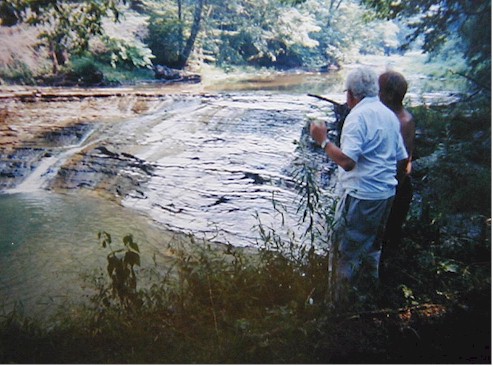
they approached the waterfall along Six Mile Creek. "I used to bring
campers here when I was a counselor at the camp up the road." This
unexpected connection to her past brought my mother fully into the excitement of
the day. The journey had begun with a very different intent…to trace the
origins of Cowell Boat Works, the maker of my father's 1957 16-foot outboard
runabout. The waterfall on Six Mile Creek Although the Cowell name is still known in Erie, Pennsylvania,
Cowell boats are all but forgotten. The family's standard bearer today is
Richard Cowell, an attorney practicing in Erie. His late father Tom was the
founder of Cowell Boat Works. Richard was with my parents this day, graciously
accompanying them on this unannounced probe into his family's history. Cowell Beach is accessible only by the Cowells' private drive,
which my parents and their Erie friends, the Sorces, hesitantly followed through
the vine-laden woods. They reached the two-story frame home where Richard grew
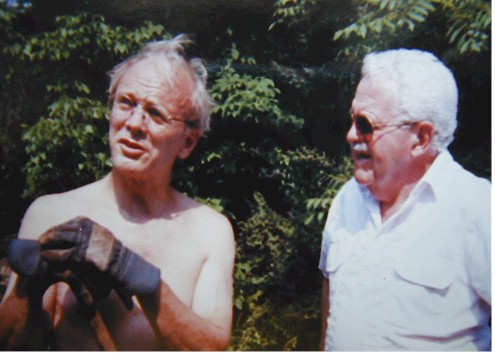
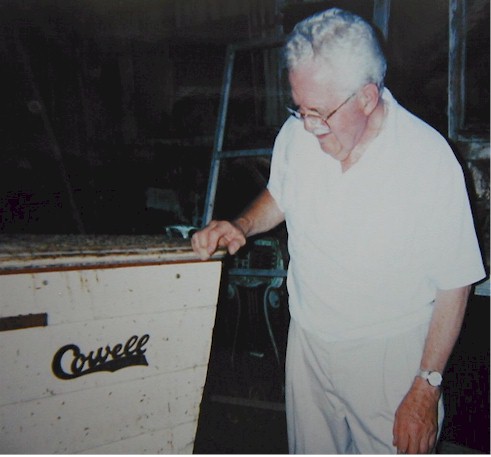
up, and proceeded toward the bluff that overlooks the beach. Richard Cowell and one-boat-man Dek Kanally They passed a cottage and a barn, and then saw Richard
gathering and burning driftwood on the beach. He climbed the bluff to greet them
and showed them around the property, including its own natural wonder, the
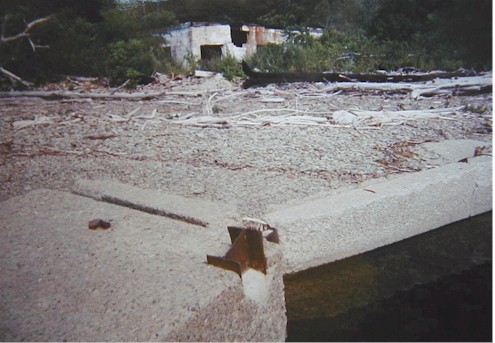
waterfall along Six Mile Creek. The old pier and Cowell Boat Works buildings
in '99 They gingerly picked their way down a steep path toward the
beach where Richard and his wife Jane had been clearing the driftwood. There,
massive concrete slabs and reinforcing steel that once were a boat slip and pier
lay askew, victims of forty years of Lake Erie freezes and thaws. And a bit
farther up the beach were the crumbling remains of the buildings where Cowell
boats were made. Doors and windows were long gone. The paint was splotchy. The
vines and bushes that dominated the property were well on their way to
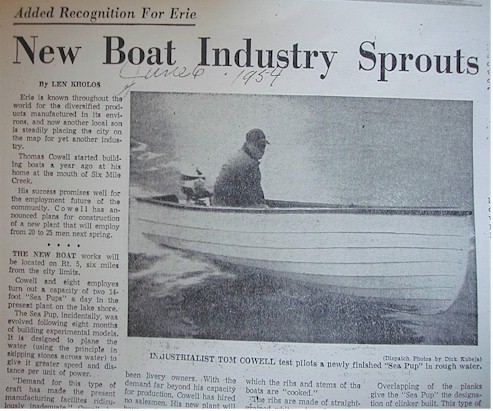
reclaiming these buildings as well. Cowell Boat Works in its Heyday A June 1954 newspaper article proudly announced the expansion
of Cowell Boat Works. Thomas Cowell had been building wooden boats at his home for
about a year, largely for the boat livery trade. He had experienced sufficient
demand to expand operations and employ several craftsmen. One of those young craftsmen was Ron Smith, who honed his
woodworking skills on the mahogany gunwales and decks of many boats, including
the one that my father would one day own. Ron, who has been building homes in
Erie for the past 25 years, cited this early work experience on the home page of
his construction business web site. It was this single Internet reference to
Cowell Boat Works that opened the door for our discovery of Cowell's history in
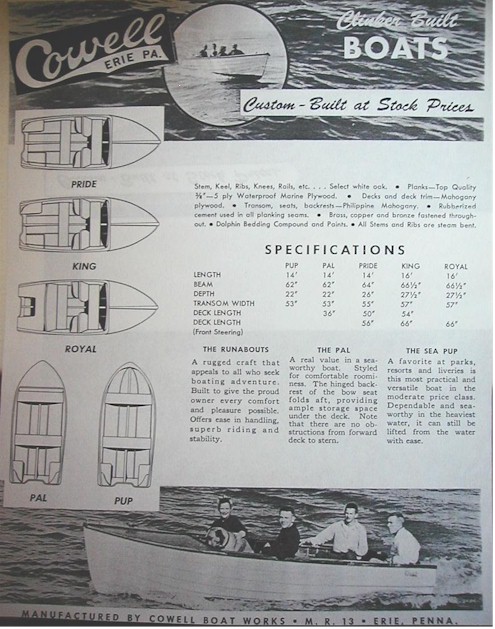
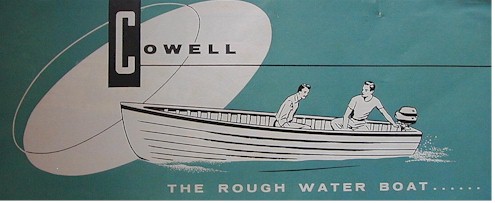
the summer of 1999. From Richard's family archives came brochures that detailed
the various models in the Cowell line. "Sea Pups" were the open
fishing boats used with small engines, driven from the stern. Our boat was
clearly one of the runabouts, a "King". Other materials from Richard included a publicity photo made
in the late 50's with employees, neighbors and friends aboard, including young
Ron Smith at the wheel. Completing their tour of the Cowell property, my parents saw a
late 1950's Cowell 19-footer, sheltered in the Cowell's barn since it came from
the shop. Dek at the stern of the Cowell's 19-footer, June '99 But our family's Cowell boat story began over a decade later,
in 1969. The Muskrats and Boat Ownership Peer
Pressure Our first encounter with Cowell boats was unintentional.
Sometime early in the summer of 1969 we decided that boat ownership was
desirable. Our family, together with three other families known collectively as
"The Muskrats", had shared a summer rental cottage on Bemus Bay at
Chautauqua Lake, New York. Throughout these summers, the kids of all four families spent
most of their school vacations at the lake. The parents, who had
responsibilities to their work, rotated the weekday kid-sitting burden, each
couple taking their turn watching all the kids during one week of the summer. On
weekends, though, everyone from the first and second generations of Muskrats was
at the lake. In the early years, we had access to one boat, a Penn Yan
16-footer with a gutsy Johnson 60-horse belonging to Phil and Jewell Meacham,
the senior Muskrats. Behind this boat, every young Muskrat learned to water ski.
Soon thereafter, our bright red, square-stern fiberglass canoe, the Muskrat,
joined the flotilla. No perch or bluegill was safe from a junior Muskrat
dropping his line over the gunwales of this stealth craft. Not to be outdone, fellow Muskrat H.S.J.B. (more about him
later) added two crafts to our Navy: The Ramstuk, (can you find the word Muskrat
therein?) a featherweight oak and plywood rowboat and Remister II, a tiny
sailing tub named after H.S.J.B.'s hoss. (H.S.J.B. was bohn and reahed
in Boston, but lived and kept hosses in Pennsylvania). No other Muskrat
had horses or sailboats, so it was good for us that H.S.J.B. was in our midst. This floating frenzy culminated in a trip to the Starbrick
Marina in Warren, Pa. by my father, my younger brother Kevin and me, in June of
1969. We drooled a bit over the new-looking and new-smelling boats in the
showroom, but our budget led us quickly to the back parking lot where, sitting
alone and sorely neglected, was a blistering and peeling wooden runabout of
noble lineage. A swooping script logo, "Cowell, Erie, Pa." was affixed
to the rear hull, on the port side. We immediately saw the potential and
overlooked the shortcomings of the slightly shabby craft. A few hundred dollars
later, we drove off with the boat, a 45-horse Mercury outboard and a Cox trailer
built for the millennium. (Thirty-one years later, all three items would prove
themselves to be Y2K compliant.) When we pulled into the driveway, my mother's expression let
me know that no parental pillow talk had preceded this purchase. This
"honey, guess what!" buying technique has served me well over the
ensuing years. Kevin Kanally effects the first restoration,
1969 We set straight to the work of restoration. A stained blister
on the front deck plywood was injected with glue with a veterinarian hypodermic
needle, pushed flat with weights, then sanded. All topside surfaces received
several coats of spar varnish. The hull was painted with white marine enamel. In
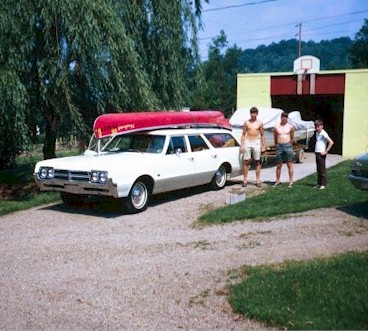
short order, the new old boat was ready for launch. The Muskrat, the Olds and young Muskrats
David, Kent and Kevin in 1969 H.S.J.B., denatured alcohol, and the
"fish-pound" theory. "Handsome Smiling Jerry Bozzo" he signed his cards
and letters. An engineer by training and a corporate executive, gentleman
farmer, building supplies retailer, and hoss owner by profession, H.S.J.B. had
knowledge of most subjects, especially those involving mechanics, electronics,
chemistry, boats, dock building, and horses. This knowledge impressed us young Muskrats deeply, and came in
particularly handy on the day we launched the new old boat. Any given body of water (in this case Chautauqua Lake) is
capable of supporting a certain poundage of fish life. This poundage
could be comprised of (a) a large number of small fish or (b) a small
number of large fish. Since any self-respecting fisherman would prefer
the latter scenario, it is important for all fishermen (especially
young Muskrat fishermen) to do their part to eliminate undersized fish
from the population. This way, the fewer remaining fish could grow
bigger, to the benefit of everyone. It is due to the practice of this
fish-pound theory that between 1965 and 1970, scores of hapless
late-blooming adolescent Chautauqua Lake bluegills were mercilessly
slammed against the planks of the Muskrat boat dock, where they
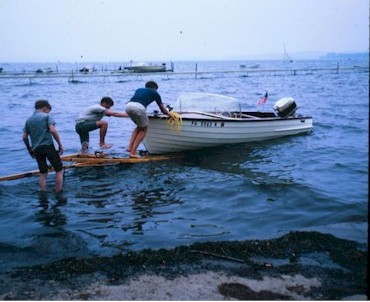
briefly twitched, then met their maker. The Launch and the Sputter Hesitantly, with multiple re-orientations, we backed the
trailer down the public boat ramp at Bemus Point. The fresh varnish reflected
the upstate New York partly cloudy skies. The fresh, new American flag fixed to
the stern light snapped in the lake breeze. After the ceremonious shove-off, we
cranked the Merc and she turned over just as she had done at the Starbrick
Marina. My brother, my buddy Kent (elder son of senior Muskrats Phil and Jewell)
and I were to pilot the boat back to the cottage. The fateful first launch, 1969 But then our hearts sank. The motor would run only at half
throttle. We chugged around the bay a bit, pulled the cowling from the motor and
pretended to adjust things, to no avail. Dejected, we returned to port and
trailered the boat back to the cottage. H.S.J.B.
and Senior Muskrat George "Casey" Case (who left this life way too
soon) on
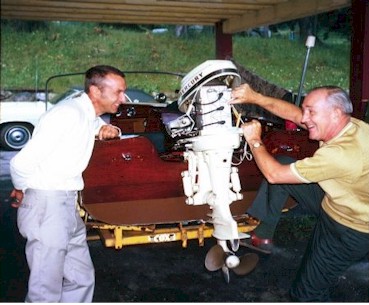
the day of the carburetor miracle H.S.J.B. to the rescue. His expert diagnosis revealed that the
lower carburetor was clogged with "vahnish", the dried residue of the
28:1 gas/oil mixture that the 1960 power plant burned. He also determined that
denatured alcohol would make a suitable solvent for said vahnish, because it was
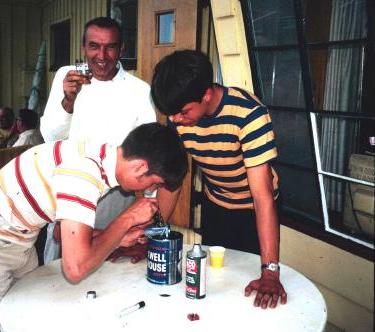
"sufficiently volatile." We young Muskrats accepted this diagnosis at
face value. Kent
and David ream the carb jet with denatured alcohol while H.S.J.B. conducts
a volatility evaluation on a Manhattan, 1969 With youthful bravado and close coaching by H.S.J.B., we
pulled the lower carb, dismantled it and reamed out the jet with a denatured
alcohol-soaked broom straw. Following careful reassembly and remounting of the
carburetor, we dragged a 55-gallon drum to the stern of the trailered boat,
pulled the drum up and around the lower housing of the motor, and filled the
drum with water. This time, the Merc not only turned over, but whined into the
highest rpm range, churning and spewing water like a possessed eggbeater. We
were mechanics! All thanks to H.S.J.B. The "Middle Years" and the
Mortician As young Muskrats grew into adulthood, the Chautauqua summers
came to an end. The new old boat was due for another restoration. The blister on
the front deck had risen again, and the stains just seemed to get worse and
worse. We were understandably concerned for the boat's health, but nothing could
have prepared us for the day the Mortician showed up. What relief we felt when
it became clear that Frank Switzer wasn't there to bury the boat, but to improve
it. You see, in a town the size of ours, there aren't enough people dying to
keep a mortician busy full time. So Frank laid tile and did upholstery on the
side. His solution to our blemished front deck was to cover it with a
high-quality nut-brown colored vinyl upholstery material, which he did, quickly
and masterfully. Seats, gunwales and other remaining woodwork received numerous
new coats of spar varnish, and the new old boat was ready for the middle years. Empty nesters Kanallys, Delacours and Paynes
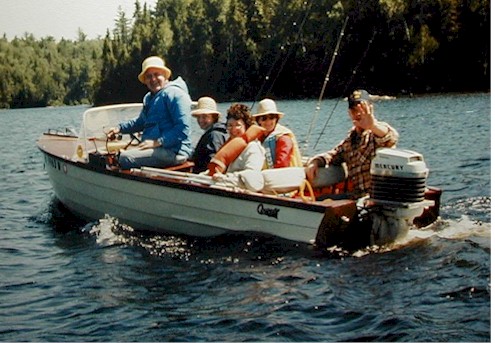
cruising Kippawa Lake, Quebec, 1981 Since we kids were grown and gone, my Dad used the boat for
two main purposes: to take a couple of other people's young kids fishing at
Chautauqua Lake from time to time, and to travel with my Mom and several other
empty nest couples to Kippawa, Quebec, for week-long fishing trips. At some undocumented point during this period, the boat and
trailer both received a coat of cream-colored paint to match the new Olds
station wagon. Hagar's Magnificent Obsession Something came over my father in 1985. He had a vision of a
completely restored new old boat. He began a process which would fill our
garage, consume his time and challenge my mother's patience for nearly two and a
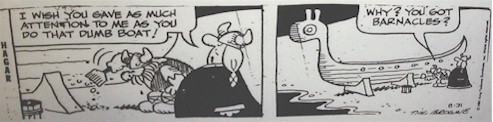
half years. At some point during this time, my mom began calling my dad
"Hagar" after the boat-loving Viking of comic strip fame. She laminated and displayed this and other Hagar comic strips
on the wall of the garage as her quiet vigil continued. Hagar and Helga set the tone for all boat
restoration projects to come, 1100 A.D. A hardy band of guys led by Bob Hartle, our town's second
underemployed mortician, came to help Dad flip the boat so he could begin
removing the multiple coats of paint. With a heat gun and scraper he spent
evening after evening scraping through layers and layers of cream, white, green,
yellow and other colors of enamel until he reached bare wood. My
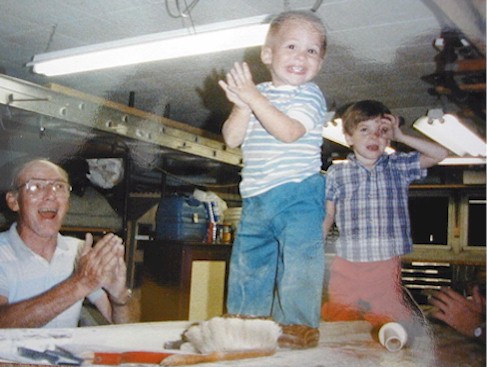
father-in-law, Ken McLaughlin (who also left this life way too soon) and our sons
Eric and Brian atop the partially scraped hull, celebrate Dek's progress in 1985. Once the scraping phase was complete, the guys re-righted the
boat. Dad removed the troubled front deck entirely, and replaced it with brand
new marine mahogany plywood and trim that he had to drive 9 hours—all the way
to White Plains, NY-- to get.


It is important,
albeit irrelevant, to insert a brief expose of H.S.J.B.'s
"fish-pound" theory at this point:
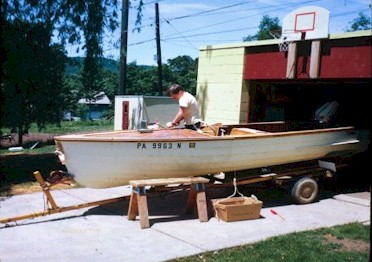
For all the Hagar teasing he got, it is important to note that my dad is a skilled and fastidious woodworker. He boiled and bent new oak ribs to replace the rotting members in the stern. He designed and built new gas tank holders and created a new seat to cover them. He raised the rear seat to accommodate both cranking and accessory batteries. He plugged screw holes with bungs, trimmed them with a tiny Japanese back saw and sanded everything until it was perfectly smooth.
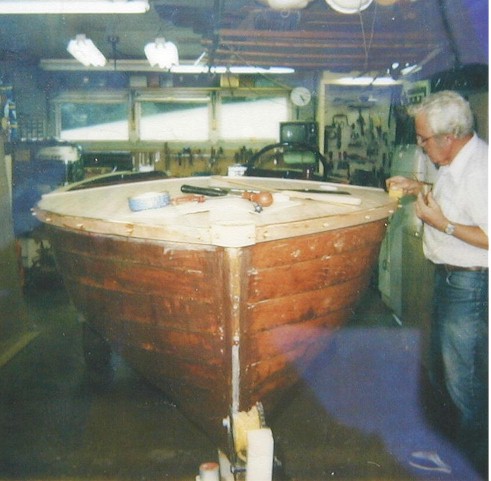
Dek plugs screw holes with bungs, 1987

During this period, Dek subscribed to Wooden Boat magazine, where he found sources for modern epoxy hull coatings, durable enamels and ultra-violet light-resistant spar varnishes.
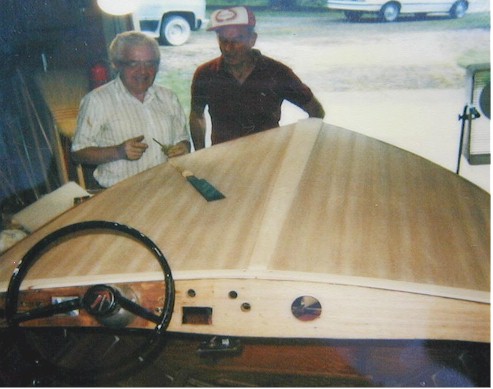
Dek and H.S.J.B. inspect the new mahogany front deck, 1987
He acquired all these products by mail order, and painstakingly applied them all to his new old boat.
The result was a mahogany jewel, glistening with a mirror finish.
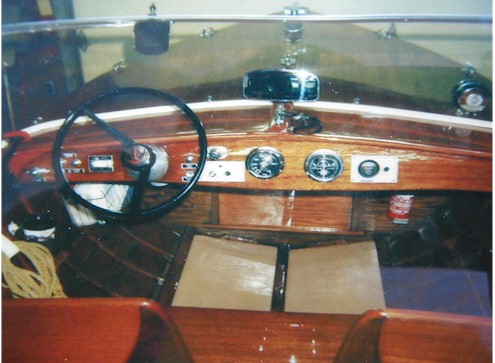
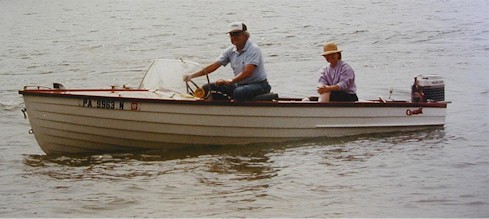
Mom and Dad launched the boat at Kinzua Dam near Warren, Pa., where Mom officially christened the boat "Hagar".
Troubled Trip to Texas
Hagar (the boat, not the Viking) made a few trips during the years between 1987 and 1999…mostly day trips or weekends to Chautauqua Lake or Kinzua Dam. Lately, though, the new old boat had been in storage most of the time, and my dad thought it was about time to pass it along. I was thrilled at the prospect of being the new owner of the boat, but one major logistics challenge lay ahead…how to get the boat from Pennsylvania to Texas in a time-efficient and economical way.
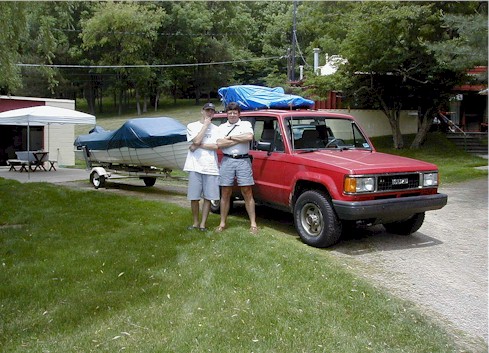
Brian and David: Texas or Bust, June '99
After considering several options, we decided that it would be best to acquire my brother's 1988 Isuzu Trooper (which he was looking to sell anyway) , tow the boat to Dallas, then sell the Trooper. Our elder son Brian and I would do the driving.
Good plan, but the Trooper didn't have a rear bumper, and the hitches that were locally available in Pennsylvania required one.
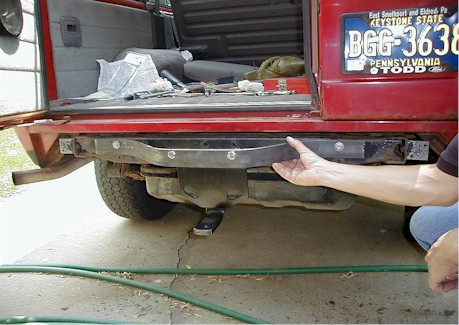
Hitch Solution #1
So we had to add a supporting member to the rear frame of the Trooper to support the hitch. This modification held up for the first 250 miles of the trip, getting us to the west side of Akron, Ohio, Medina to be precise. At that point the rusting rear frame gave way, and we needed the intervention of some professional welders to reinforce the hitch to make sure we could finish the remaining 1200 miles of the journey.
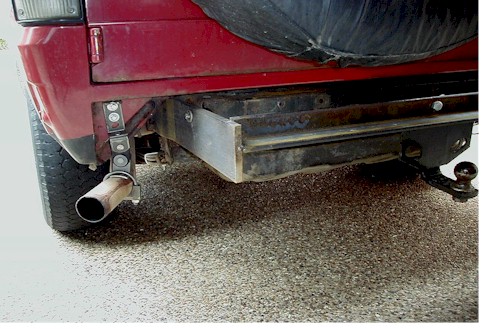
Hitch Solution #2
We found a welding shop that would do the work, which caused a half-day delay in the journey, but only a minor blip in the project budget. We finished the trip without further incident and found a new home for the new old boat in North Texas.
Finding the Good Life in Texas
Since coming to Texas, the Kanally Cowell has become affiliated with the Antique and Classic Boat Society (ACBS) and the Wooden Boat Association of North Texas. The Cowell has been in several shows, including the Texas State Fair, the Annual WBA Show & Ride at Lake Lewisville, and the Annual Keels and Wheels show at Clear Lake.
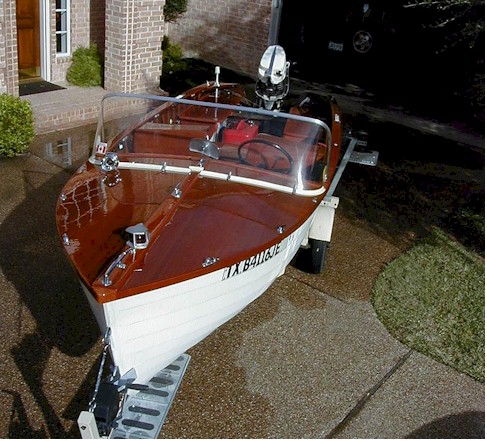
New coat of Epifanes Spar Varnish, November 2000
The boat that one man loved is now safely in the loving care of another. The new old boat is plying the new millennium in ship shape. The new owners are thankful that Dek's craftsmanship and care have made this all possible.
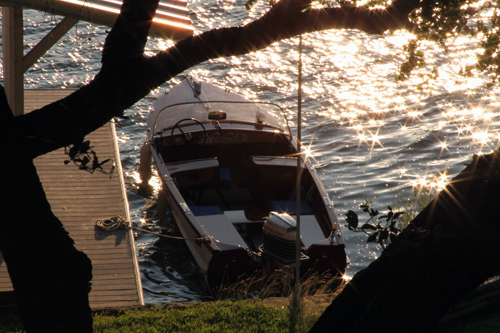
On Lake LBJ in Texas, October, 2012.